What is the price of an ERE?
In July 2026 the market price of a single ERE certificate ranges between €0.48 and €0.50, which works out to roughly €0.16 to €0.17 per charged kWh. There is no fixed price — the value is set by supply and demand. This article explains how that works, why the price fluctuates, and what it means for your payout.

How is the price of an ERE determined?

The ERE price is set by supply and demand in the market. Two sides influence the price:
The demand side: fuel suppliers
Oil and fuel companies are legally required to offset part of their CO₂ emissions. This obligation flows from the Fuel Transition Obligation (BTV), the successor to the Annual Transport Energy Obligation. To meet it, they buy ERE certificates. The higher the obligation, the more certificates they need — and the greater the demand.
The supply side: charger owners and other sources
The supply of EREs comes from parties that demonstrably save CO₂. Think of:
Home chargers who have their kWh registered via a charger with a MID meter.
Public and semi-public charging points.
Biofuel suppliers bringing renewable fuels to market.
The more certificates are available on the market, the lower the price can go — and vice versa.
Price explanation and market indicator
The reward for EREs (Emission Reduction Units) is determined by the current market value on the emissions market. Three factors matter here: the gross market price, the sales costs on the emissions market, and the registrar's commission.
Registrars collect kWh and sell the CO2 reduction (EREs) on the open market to fuel suppliers.
About ±1.5% is withheld for the transaction on the trading exchange (sales costs of the emissions market).
The booking service provider withholds a percentage for audit, NEa registration and administration.
Business drivers can deduct the VAT on the commission; for individuals the commission includes 21% VAT.
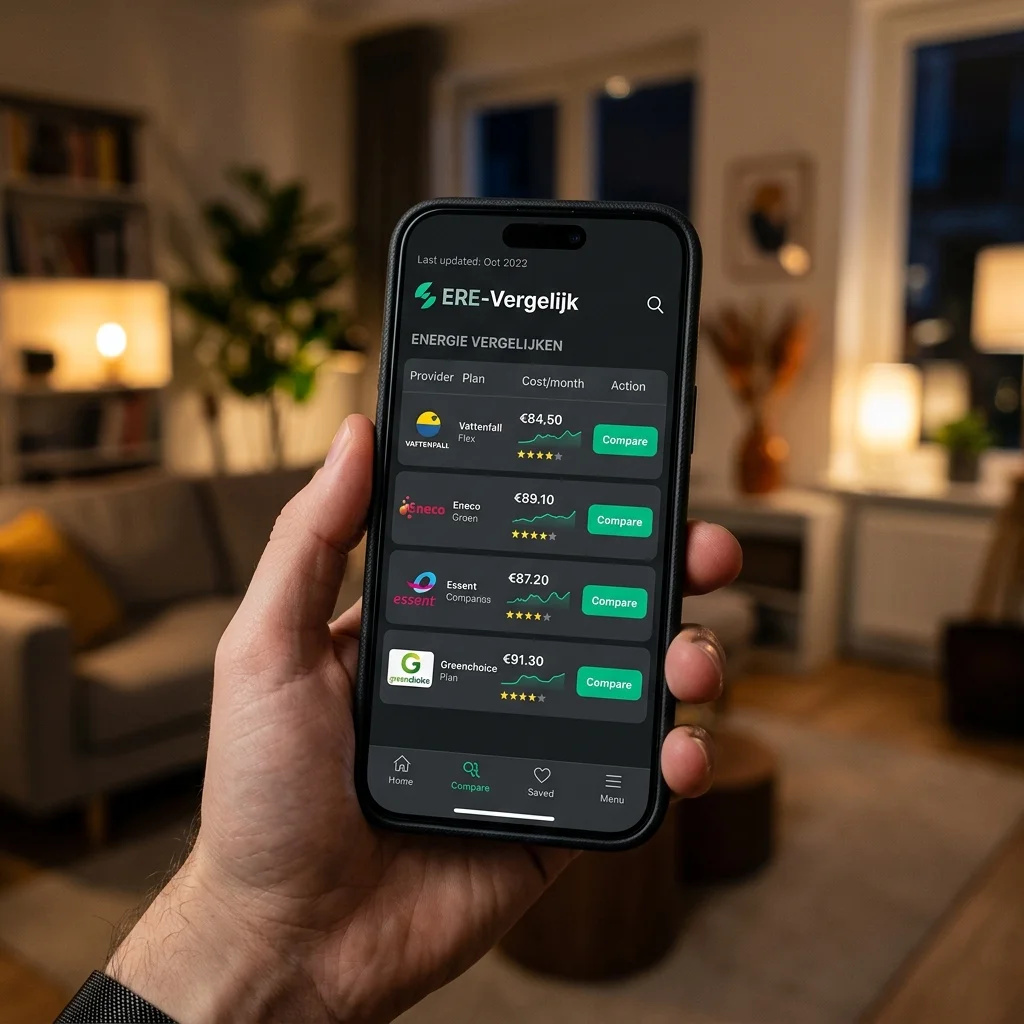
In our comparison tool you see the earnings after deduction of all the above costs.
Comparing is 100% free
Current Market Value (Benchmark)
€0.45 – €0.51 per ERE
Calculation value: €0.49 per ERE
≈ €0.16 per charged kWh
Reference date: August 2026 · indicative market range
From kWh to certificate: how does the conversion work?
One charged kWh does not automatically produce one ERE certificate. The conversion is based on a Europe-wide formula (from the revised Renewable Energy Directive, RED III), in which the CO₂ emissions of fossil fuel serve as the reference.
For private individuals, the average share of renewable energy in the Dutch electricity grid is the starting point. In 2026 that is around 50.5%. This yields approximately 0.33 ERE per charged kWh.
Do you have solar panels? As a private individual you do not receive more ERE certificates than someone without panels — the NEa itself lists this as a common misconception (source: NEa guidance document, Dutch).
For business users, it is possible to demonstrate that the electricity supplied is 100% renewable — for example via an exclusive green grid connection or a separate metering setup. In that case the yield can rise to roughly 0.66 ERE per kWh.
Why does the ERE price fluctuate?

The ERE price is not stable. Several factors can push the price up or down over time.
Factors that can push the price up
Rising legal obligation — the mandatory reduction percentage for fuel suppliers rises from 14.4% in 2026 to 28.4% in 2030. This means structurally rising demand for ERE certificates.
More ambitious climate targets — if the government tightens its CO₂ goals further, fuel suppliers will need even more certificates.
Seasonal demand — around the deadline of the annual obligation, demand can briefly peak, driving prices up.
Factors that can push the price down
Growth of electric transport — the more EV drivers and connected charging points there are, the larger the supply of EREs. That can put downward pressure on the price.
A greener grid — a higher share of renewable energy in the grid means more EREs per kWh for every charger. That increases the total supply.
International biofuel market — biofuels remain a major source of EREs. Lower biofuel prices or higher imports can grow the total supply.
Regulatory changes — adjustments to the fossil reference value, double-counting rules or other policy changes can affect the value of EREs.
What does a charger owner get for an ERE?
As a home charger you do not receive a direct payment per ERE certificate. Your booking service provider collects your charging data, converts it into certificates and sells them on the market. You then receive a payout per charged kWh, minus the provider's commission.
At the August 2026 market range (€0.45 – €0.51 per ERE; we calculate with €0.49), a charged kWh works out to a gross payout of €0.15 to €0.17.
Note: this is a gross figure. Your booking service provider's commission still comes off the top.
How much can you earn from EREs per year?
Your final payout depends on three factors:
The number of kWh you charge per year.
The market price of ERE certificates at the time of sale.
The commission your booking service provider charges.
Calculation example
In this example we assume a gross consumer payout of €0.16 per kWh and a commission of 20%:
Occasional home charging — around 1,500 kWh per year. That yields €240 gross and €192 net.
Average home charging — around 2,500 kWh per year. That yields €400 gross and €320 net.
Heavy home charging — around 4,000 kWh per year. That yields €640 gross and €512 net.
Intensive home charging (2 cars) — around 6,000 kWh per year. That yields €960 gross and €768 net.
Note: this is a calculation example, not a guarantee. The actual payout depends on the ERE market price at the time of sale and your booking service provider's commission.
Find the best booking service provider
Compare ERE booking service providers with our independent comparison tool and lock in the most favourable terms.
Compare nowCalculation example: Individual (Home charger)
Based on approx. 1,500 generated EREs per year.
Calculation example: Business (Office / VvE)
Based on approx. 25,000 generated EREs per year.
How will the ERE price develop?
No one can predict the exact price trajectory, but there are two clear opposing forces:
Pushing prices up: the legal reduction obligation for fuel suppliers nearly doubles — from 14.4% in 2026 to 28.4% in 2030. That means structurally higher demand for ERE certificates.
Pushing prices down: the number of electric cars and charging points is growing fast, and the electricity grid is getting greener. That increases supply.
The final price depends on the balance between this demand and supply.
Frequently asked questions about the ERE price
What is the price of an ERE?
In July 2026 the market price of a single ERE certificate ranges between €0.48 and €0.50. Translated into what you receive as a home charger, that comes to a gross payout of roughly €0.16 to €0.17 per charged kWh.
Is the ERE price fixed?
No. ERE certificates are traded on an open market, comparable to other commodity markets. The price changes continuously based on supply and demand. There is no government-set fixed price.
How many EREs do I get per kWh?
That depends on the share of renewable energy in the electricity you charge with. As a private individual the grid average is the starting point — in 2026 that is around 50.5% renewable. This yields approximately 0.33 ERE per charged kWh.
Do I get more EREs if I have solar panels?
No, not as a private individual. For private individuals the NEa calculates with the average renewable share in the electricity grid, regardless of whether you have solar panels. You do save on your energy bill by charging for free with your own electricity, but you do not receive more ERE certificates. Only business users who can demonstrate that their electricity is 100% renewable qualify for a higher payout.
How much can I earn from EREs per year?
That depends on how many kWh you charge per year, the market price at the time of sale and your booking service provider's commission. At a gross payout of €0.16 per kWh and 20% commission you earn around €192 net at 1,500 kWh per year, rising to around €768 at 6,000 kWh per year.
What is the difference between gross and net payout?
The gross payout is the amount based on the market price per kWh. The net payout is what you actually receive after your booking service provider's commission has been deducted. This commission differs per provider.
Can the ERE price still rise?
It is possible. The legal reduction obligation for fuel suppliers rises from 14.4% in 2026 to 28.4% in 2030, which structurally increases demand for ERE certificates. On the other hand, supply also grows due to more electric cars and a greener electricity grid. The final direction depends on the balance between supply and demand.
When do I receive my ERE payout?
You receive the payout via your booking service provider. The timing and frequency of payouts differ per provider — some pay quarterly, others annually. Check the terms of your specific provider.
How does the ERE payout differ per booking service provider?
Booking service providers use different commission percentages and payout terms. The gross market price per kWh is the same for everyone, but what you receive net differs. It pays to compare providers on commission, payout frequency and contract terms.
Was this article helpful?